
| |
Educación escolar

Celia Gallardo Herrerías 1
1  0000-0001-5515-1269 Universidad de Almería, Spain
 cgh188@inlumine.ual.es
Received: 11/09/2025
Submitted to peers: 03/11/2025
Accepted by peers: 03/01/2026
Approved: 06/02/2026
Para citar este artículo / To reference this article / Para citar este artigo: Gallardo Herrerías, C. (2026). Manipulatives in Mathematics Education: United States and Spain. Educación y Educadores, 28(3), e2834. https://doi.org/10.5294/edu.2025.28.3.4
Abstract
This study seeks to bridge a significant knowledge gap in comparative studies of mathematics education regarding the practical application of knowledge across international settings. Its general objective is to analyze the use of manipulatives in learning mathematics in the USA and Spain, focusing on the Californian and Catalan regions. To this end, this research employed a comparative case study of the use of virtual manipulatives for learning mathematics, involving 80 mathematics teachers from the USA and Spain across 40 primary and secondary schools in both countries. The study has demonstrated that teachers in America make greater, more measured use of manipulatives, supported by strong curriculum alignment, staff development programs, and coaching. Nevertheless, while attitudes towards manipulatives remain highly positive in Spain, teachers have felt limited in their practice due to systemic challenges such as class size, inadequate professional training, and a lack of curriculum guidance. The study highlights that physical manipulatives are used to a greater extent within both countries, while virtual learning tools have increasingly become part of secondary education within the USA. Overall, the study reveals that the impact and frequency of manipulative use appear to be influenced not by the teacher but by the broader context, highlighting the importance of school reform initiatives that address the particular system and cultural traditions in an effort to promote more learning for the teacher and specificity in the curriculum for the successful integration of hands-on learning resources.
Keywords: Education; pedagogy; mathematics; cross-cultural analysis; learning.
Resumen
Este estudio busca cerrar la brecha de conocimiento en los estudios comparativos sobre educación matemática respecto de la aplicación práctica del conocimiento en entornos internacionales. El objetivo es analizar la aplicación del aprendizaje mediante manipulativos en Estados Unidos y España, especialmente en California y Cataluña. Se realizó un estudio de caso comparativo sobre la aplicación de manipulativos virtuales para el aprendizaje de las matemáticas con 80 profesores de Estados Unidos y España, en 40 escuelas primarias y secundarias. Se demostró que los maestros en Estados Unidos hacen un uso mayor y más medido de los manipulativos, con apoyo de una sólida alineación curricular, de programas de desarrollo del personal y de coaching. Si bien las actitudes hacia los manipulativos siguen siendo positivas en España, los maestros se sienten limitados en su práctica por desafíos sistémicos como el tamaño de la clase, la capacitación profesional inadecuada y la falta de orientación curricular. El estudio destaca que los manipulativos físicos se utilizan con mayor frecuencia en ambos países, mientras que los virtuales se han integrado cada vez más en la educación secundaria de Estados Unidos. Se concluye que el impacto y la frecuencia del uso de manipulativos parecen verse influenciados no por el docente, sino por un contexto más amplio, lo que destaca la importancia de las iniciativas de reforma escolar que abordan el sistema y las tradiciones culturales particulares para promover un mayor aprendizaje en el docente y la especificidad del currículo en la integración exitosa de recursos de aprendizaje práctico.
Palabras clave: Educación; pedagogía; matemáticas; análisis intercultural; aprendizaje.
Resumo
Este estudo busca reduzir a lacuna de conhecimento nos estudos comparativos sobre educação matemática em relação à aplicação prática de conhecimentos matemáticos em contextos internacionais. O objetivo é analisar a aplicação da aprendizagem com materiais manipulativos nos Estados Unidos e na Espanha, especialmente na Califórnia e na Catalunha. Um estudo de caso comparativo sobre a aplicação de manipulativos virtuais para o ensino e aprendizagem da matemática foi realizado com 80 professores dos Estados Unidos e da Espanha, em 40 instituições de ensino fundamental e médio. Professores dos Estados Unidos demonstraram fazer uso mais frequente e mais criterioso de manipulativos, apoiados por um forte alinhamento curricular, programas de desenvolvimento profissional e acompanhamento pedagógico. Embora as atitudes em relação aos materiais manipulativos permaneçam positivas na Espanha, os professores se sentem limitados em sua prática por desafios sistêmicos, como tamanho das turmas, formação profissional inadequada e falta de orientação curricular. O estudo destaca que manipulativos físicos são usados com mais frequência em ambos os países, enquanto manipulativos virtuais têm sido progressivamente integrados ao ensino médio nos Estados Unidos. Conclui-se que o impacto e a frequência do uso de manipulativos parecem ser influenciados não pelos professores, mas sim por um contexto mais amplo, o que destaca a importância de iniciativas de reforma escolar que abordem o sistema e as tradições culturais específicos para promover maior aprendizagem docente e a especificidade curricular na integração bem-sucedida de recursos de aprendizagem prática.
Palavras-chave: Educação;pedagogia; matemática; análise intercultural; aprendizagem.
Introduction
Instruction in mathematics has witnessed a tremendous paradigm shift in the last two decades, with greater emphasis on conceptual understanding, problem-solving skills, and the application of facts in relevant, situation-specific contexts (Brislin, 1980). Some of the more important pedagogical tools employed to facilitate the aforementioned objectives include manipulatives (Aragon et al., 2023). To understand the basic application along these lines, the author emphasizes applying conceptual theory, as listed by Jerome Bruner (1964) in the "classic" sense, to enactive representations in the learning environment. Moreover, Raymond Duval's research on epistemological representations helps clarify the role of digital software as a semiotic registry through which students can access mathematical objects in unprecedented ways (Cavalcante, 2025). Manipulatives include both physical (such as base ten or fraction blocks) and virtual (such as virtual geoboards or geometry software). Manipulatives dominate in support of experiential learning or learning by experience with references to theoretical mathematical ideas and students' experience in a physical realm (Larbi & Mavis, 2016; Näslund-Hadley et al., 2014).
There exists a large, cumulative knowledge base with solid foundational data demonstrating the value of manipulatives for student learning, but a significant knowledge gap regarding their use in the educational context. As Lozada and Fuentes (2018) stated, the successful use of manipulatives is strongly linked to the educational context. First and foremost is the need to undertake a comparative study of the nature and employment of manipulatives in different contexts (Durmus & Karakirik, 2006), something particularly relevant if drawing an analogy between the United States and Spain: two very different countries with very different values in the school context and great variations in the curricular organization and the training program for teachers (Aragon et al., 2023; Strickland et al., 2007; Yang & Kaiser, 2024).
The single-country studies provide the primary foundation on which contemporary literature relies, yet lack generalizability across educational and cultural groups (Cai et al., 2009). The belief that single-country studies are a prerequisite for implementation in other countries is a flaw in the multifaceted way in which educational resources are integrated into a matrix of larger educational, social, and cultural constructs (Larbi & Mavis, 2016). A comparative model is requisite for mapping out best practices, addressing questions of system, and advancing educational interventions (Dossey & Wu, 2012; Sowell, 1989).
Although numerous studies show that manipulatives are effective in fostering understanding of mathematics and its processes, very little research has examined how countries differ in their use of manipulatives, for instance, to promote understanding among readers (Larbi & Mavis, 2016).
Larbi and Mavis (2016), to some extent, through their study of the cultural aspects of mathematics education in various countries, argue that individualist and autonomous mindsets in nations like the U.S. are extremely different from those in countries with more centralized and collective mindsets, like Spain. However, in mathematics education, there has not been a comprehensive comparative study of various aspects, aside from studies of quantified pupil achievement outcomes, such as those from PISA and TIMSS. For instance, there has not been a clear picture of how various nations implement manipulatives in mathematics education, how countries differ in such application, and how those differences may influence learning outcomes.
Additionally, there appears to be a proclivity within the somewhat small grouping of comparative literature to extend across a wide range of curricula and to inform policy-level reviews of the information itself (Cozza & Oreshkina, 2013). In contrast, there is a nitty-gritty level in terms of how a teacher lets their instruction play out within a day-to-day level with regards to their respective classroom, and how a student lets manipulatives play out in response to various instructional models based on manipulatives (Fang & Gopinathan, 2009; La Ferla et al., 2010; O'Shea, 1993).
More specifically, new digital technologies have expanded the manipulatives' repertoire, shaping how teachers use them in classrooms. The implementation of digital manipulatives has not been comprehensive across all countries, yet no comparative studies exist (Cozza & Oreshkina, 2013). Keeping in mind that the rate of technological change signals that the issue requires immediate consideration to understand the implications of these changes across national education systems. By clearly specifying the overall purpose—the purpose of comparing the incidence and use of manipulatives in California and Catalonia—we expect this research to generate the insights needed from the system's perspective.
The study aims to bridge these gaps by comparing manipulative materials in mathematics education in the United States and Spain. The secondary objectives of the study are enumerated below:
To classify and determine the kinds of manipulative materials (physical and virtual) that are commonly used in American and Spanish mathematics classrooms.
To explore the prevalence and setting of the use of manipulatives in math instruction throughout the primary and secondary phases of education in both countries.
To explore teachers' conceptions, ideas, and staff development for the use of manipulatives within each setting.
To compare and contrast the match between national curricula and the utilization of manipulatives, and how this affects classroom pedagogy.
To assess the impact of sociocultural, institutional, and technological factors on the use of manipulatives in the learning-teaching process.
To offer practical suggestions to teachers, policymakers, and curriculum developers to utilize manipulatives more effectively in the classroom.
Research Questions
With these objectives in mind, the following research questions will be answered:
What manipulative resources are used most often in United States and Spanish mathematics classrooms, and how do they differ from each other?
How consistently are manipulatives used in mathematical instruction at different levels of schooling (primary vs. secondary) within each country?
What types of pedagogical functions are used by teachers to elicit manipulatives, and how do they vary across environments?
What are teachers' perceptions of the worth of manipulatives to support student understanding and engagement in the United States and Spain?
What preparation and materials for the use of manipulatives do teachers in both nations have access to?
How do national curriculum documents and policy reports in both nations encourage or impede the use of manipulatives to teach mathematics?
What is the function of digital manipulatives in each context, and what are their strengths and limitations for instructors?
How do general sociocultural and institutional limitations (e.g., class size, facilities at school, teacher autonomy) affect the use of manipulatives in the United States and Spain?
Method
This research will employ a comparative case study with a mixed-methods design to explore manipulative materials used in mathematics teaching and learning in Spain versus the United States. In this design, qualitative and quantitative techniques are combined in an intensive study to provide a detailed description of the problem, enabling the study of complex pedagogical phenomena across different cultural contexts. Data collection was conducted over the 2024-2025 school year and comprised classroom observation, systematic teacher questionnaires, semi-structured interviews, and documentation analysis.
These were two representative regions: the state of California in the United States and Catalonia in Spain, chosen for their relevance in nationwide education, their multilingual programs, and the blend of urban and semi-urban milieus. The sample included 40 schools, 20 per country, in which two mathematics teachers participated, one at the primary level and one at the secondary level, totaling a participation of 80 educators.
Data Collection Instruments
1. Development and validation of the questionnaire: The core quantitative instrument was a questionnaire that was intended to record the nature and frequency of manipulative use. To address one reviewer's concern about the genesis of the instrument, the paper explains that the questionnaire was adapted from existing, validated instruments in the area of mathematics education, clearly identifying the dimensions from Sowell's (1989) work on the effectiveness of concrete materials and Durmus and Kara-kirik's (2006) theoretical framework for virtual manipulatives.
2. Adaptation of the questionnaire: This included a back-translation to facilitate linguistic equivalence. Additionally, a cultural adaptation process and a pilot study were conducted to enhance measurement invariance across these two distinct education systems. The tool used a Likert scale to capture the frequency of use, compatibility with curriculum guides, and educational impact.
3. Addressing response bias and implicit beliefs: The research team recognizes the research evidence that there exists a potentially strong component of response bias when closed-ended responses are utilized, as there exists a strong probability that participants would provide information that constitutes a declaration of what participants think the right answer should be (declarative knowledge) as opposed to what participants think the right answer should be that relates closely to what participants implicitly think or feel (implicit response or enacted response). However, the research did not use closed responses as a single source of information; furthermore, a triangulation method of response measurement, whereby survey data contrasts with observations, was undertaken, thus allowing the research team to establish a link between what teachers stated as practiced ("say"—declarative) and what teachers actually did in class ("do"—enacted or implicit response).
4. Classroom observation: Trained observers completed a protocol involving observing each teacher a total of two times, each time for 45-60 minutes, once while a teacher implemented a lesson that utilized a hands-on, manipulative instructional approach, and a second time while a teacher implemented a typical, standard lesson. This also enabled a measure of instructional intent, student responsiveness, and facilitation strategies, a counterpoint methodology to teacher-related questions in the questionnaires. An interrater reliability measure of 0.83 was established through Cohen's kappa.
5. Semi-structured interviews: 30 to 60-minute interviews were held with all 80 participants. A semi-structured interview approach allowed me to tap into the "hidden world" of what transpires in a teacher's mind by asking questions that helped me overcome some of the limitations of a questionnaire. Interviews are useful in obtaining a rich description of "designs and processes."
6. Curriculum and policy analysis: The study was accompanied by an analysis of various national and regional texts and curriculum guides, e.g., the CCSS in the USA or the LOMLOE/Catalonian curriculum in Spain. A coding framework was employed to ascertain specific measures or recommendations given in these publications regarding the integration of physical or digital technologies.
Data Analysis and Reliability
The quantitative survey data were subjected to descriptive and inferential statistical analyses using chi-square and f-tests to identify significant differences across countries. The qualitative dataset, collected through interviews and observations, was analyzed using NVivo software with thematic coding and the constant comparative approach. To ensure maximum rigor, double-coding of data— amounting to 20 % of the dataset—was conducted, yielding a high reliability (Cohen's kappa = 0.86).
Ethical clearance was obtained in each nation through Institutional Review Board approval; informed consent was assured in each case, and participant data in each study were pseudonymized. Yet again, through this multi-layered methodological structure, not only are the results regarding systemic and contextual influences on manipulative use assured to be valid, but they are now replicated.
Results
These results of the comparative study are organized to align with the research questions and objectives, as evidenced by surveys, classroom observations, interviews, and document analysis. Each subsection addresses a specific theme in the comparative study of Spain and the United States. The findings provide knowledgeable commentary on the varieties, frequency of use, pedagogical intentions, and contextual intentions of the implementation of manipulative materials in mathematics teaching.
Across the dataset, 80 math teachers—40 from California, USA, and 40 from Catalonia, Spain—provided rich details about their practices, beliefs, and institutional settings. Findings paint an equitable picture of the primary and secondary levels in both jurisdictions. Most noticeable is that while there were several similarities in basic knowledge of manipulatives, frequency of use, purposes for use, and use in context, these were widely variable.
Both countries had more physical manipulatives than computers, most of which were elementary. However, the tools and frequencies of their use varied. The most common physical manipulatives used in the United States were base-ten blocks, pattern blocks, fraction circles, Cuisenaire rods, and algebra tiles. In Spain, the same materials were present—specifically base-ten blocks and fraction bars—though Cuisenaire rods were less common, while abacuses and number lines were more common (see Figure 1).
Figure 1.Manipulative Materials
Source: Own elaboration.
Computer manipulatives were more commonly used in the United States, particularly in secondary education. Teachers described software like GeoGebra, Desmos, and interactive whiteboard software as key for exploring functions, geometry, and algebra. Spanish teachers reported fewer guided and more teacher-led utilization of digital software. GeoGebra was most frequently used among the software mentioned in Spain, but fewer than half of the interviewed Spanish teachers regularly used computer manipulatives.
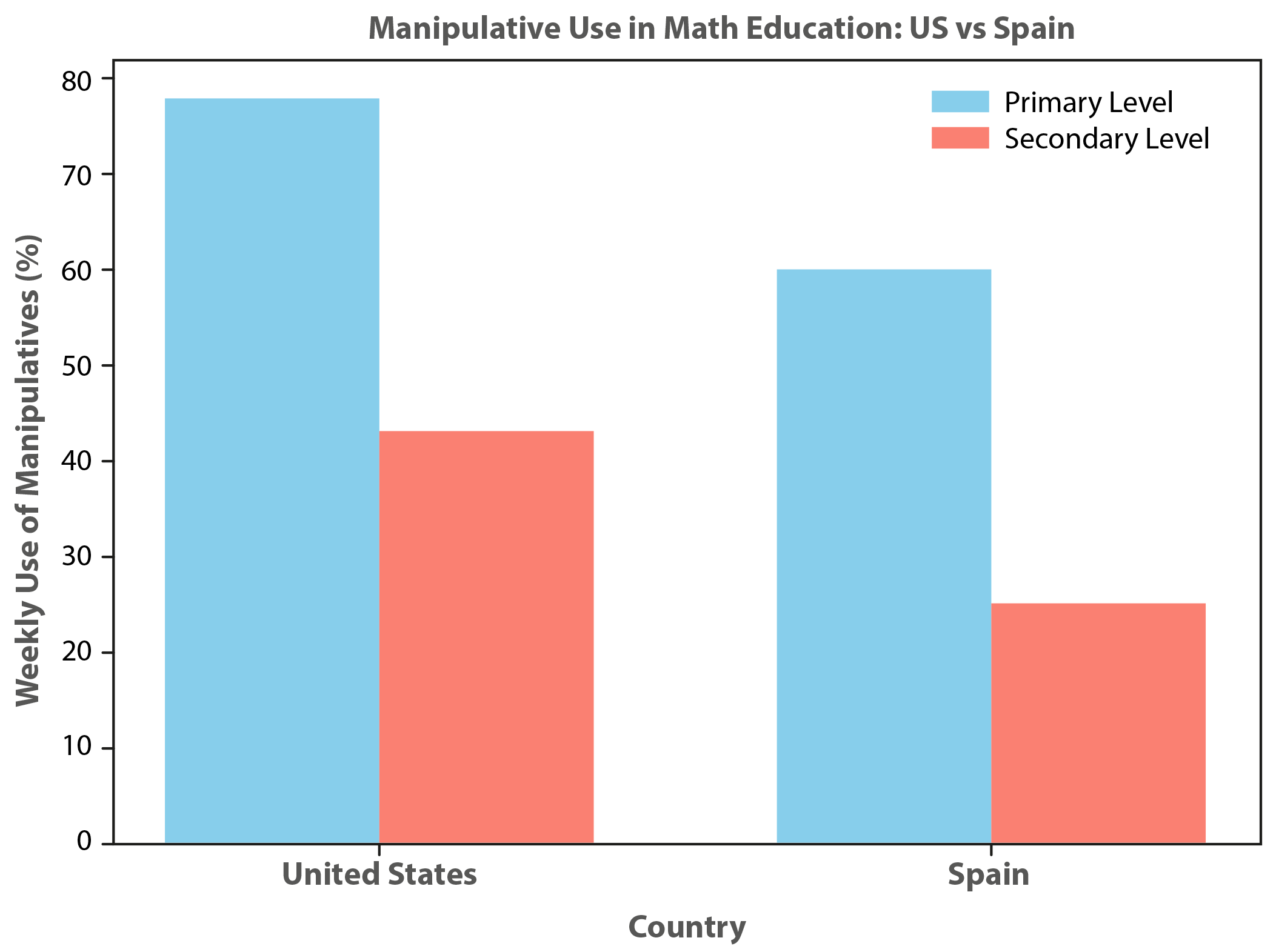
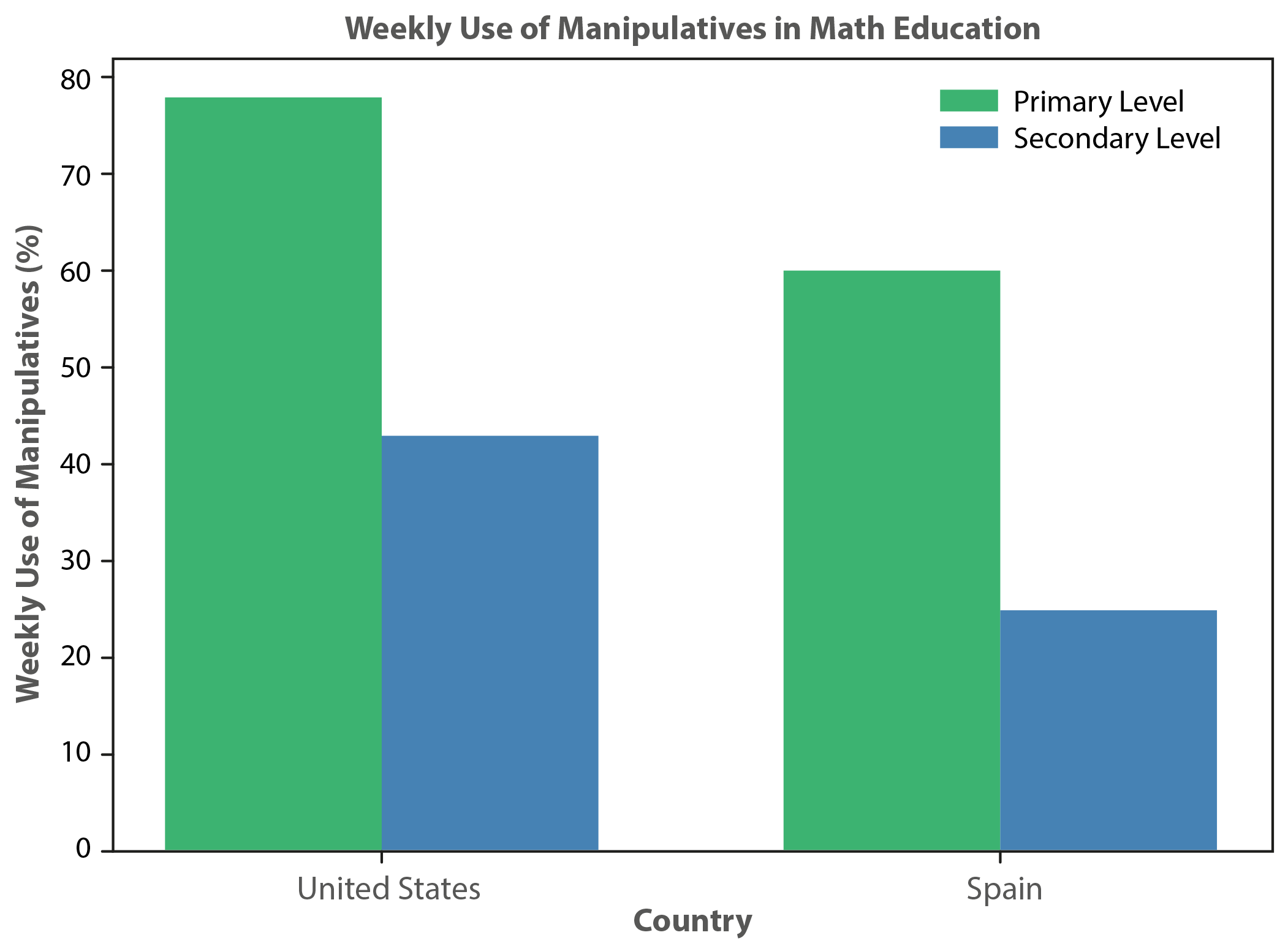
At the frequency point, 65 % of U.S. teachers reported weekly use of manipulatives, compared with only 42 % of Spanish teachers. At the primary level, it was more common in both environments: 78 % of American and 60 % of Spanish teachers reported weekly use of manipulatives. At the secondary level, it was less common: 43 % of American and 25 % of Spanish teachers used manipulatives (see Figure 2).
Figure 2. Manipulatives Frequency
Source: Own elaboration.
This is a developmentally appropriate choice in every country, with manipulatives as the material of choice for early ages in order to establish starting points for ideas. Secondary teachers interviewed, especially in Spain, complained about time pressures and curricular constraints that limit their use of manipulatives.
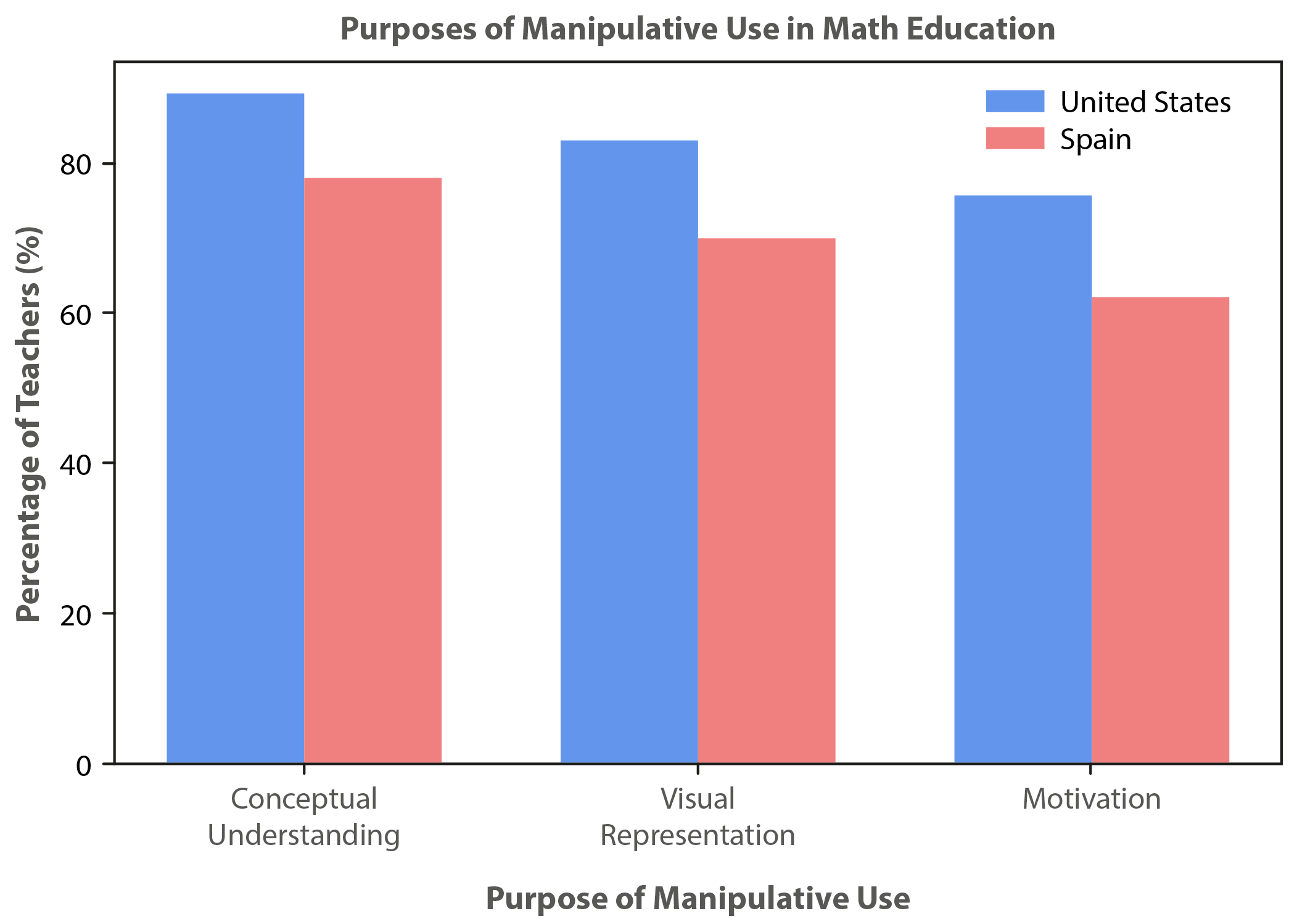
Responses to interviews and surveys confirmed that manipulatives were employed most frequently to reinforce conceptual understanding (89 % U.S., 78 % Spain), then to visually represent abstractions (83 % U.S., 70 % Spain), and for motivation (76 % U.S., 62 % Spain). Manipulatives were employed least to differentiate or for students with learning disabilities (see Figure 3).
Figure 3. Purposes
Source: Own elaboration.
Classroom observation validated the findings. American teachers most commonly used manipulatives in teacher-driven lesson plans with explicitly stated objectives. Algebra tiles, for example, were used not only as a visual aid but also as a vehicle for introducing scaffolding on the distributive property. Spanish teachers most commonly used manipulatives in student-initiated, discovery-based activities, often in line with constructivist models, but less often in direct assessment.
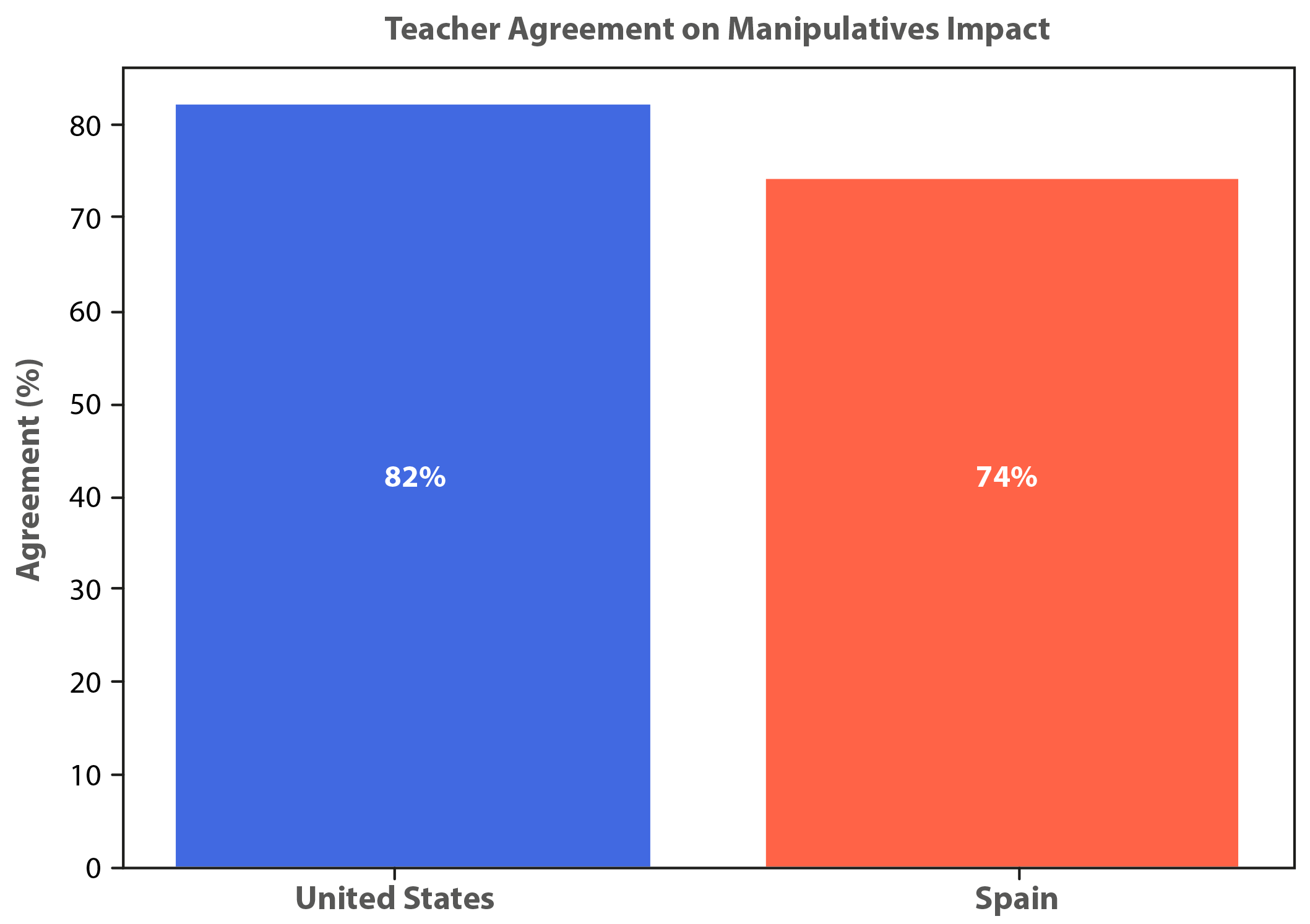
Teachers in both countries generally indicated positive orientations toward manipulatives. In the United States, 82 % of teachers agreed or strongly agreed that manipulatives have a strong impact on how students learn mathematics. The Spanish level was 74 %. There did appear to be a difference in the extent of perceived effectiveness, with U.S. teachers emphasizing manipulatives as bridging tools that lead to abstraction, while Spanish teachers viewed them as facilitating discovery and exploration (see Figure 4).
Figure 4. Teacher Agreement
Source: Own elaboration.
Interview comments also revealed an inconsistency between the attitudes of American and Spanish teachers toward student acceptance. American teachers identified manipulatives as most valuable for struggling learners and English language learners. Spanish teachers recognized its motivational value but feared wasting instructional time. A Spanish high school teacher clarified, "We find manipulatives useful, but they make us lose time. The curriculum already weighs a lot."
Staff development availability was also quite dissimilar. In the United States, 68 % of educators reported participating in manipulative training in the previous 3 years. Only 38 % of Spanish teachers reported such training. Staff development in the United States was also more likely to be hands-on workshops, demonstration lessons, and follow-up coaching. Spanish teachers generally had to look for voluntary online modules or rely on peer sharing.
In institutional support, this too was dissimilar. In America, 60 % reported having mathematics specialists or coaches in schools that actively promote the use of manipulatives. Such types of positions were comparatively uncommon in Spain. Budget and centralized provision matters were two types of issues. Spanish teachers frequently reported that requests for materials needed to pass through many layers of administrators, which deterred experimentation.
Various levels of congruence between manipulative use and the curriculum requirements were revealed through an exploration of the documents. The Common Core State Standards in the United States explicitly outline the use of manipulatives, particularly in lower grades, and the assessment models include activities that assume understanding of these tools. The LOMLOE model in Spain is amenable to manipulative use with fewer detailed instructions. Regional materials in Catalonia leaned toward active methodologies, but the systems lack specificity and accountability, leading to uneven application.
Both countries called for more specificity of curricular alignment from their teachers. American teachers appreciated the support of the standards, but at times felt they were restrictive and over-defined test parameters. Spanish teachers needed more direct instruction and hands-on lessons that used manipulatives effectively.
Digital manipulative incorporation was further enhanced in the United States, as teachers gained access to more hardware, software, and technical support. Nearly 60 % of American secondary school teachers used digital tools regularly, compared with 35 % of Spanish teachers. In elementary schools, digital use was less common in both nations, but was more common in the United States.
Concerns included inadequate training and unequal access to technology. Spanish teachers complained about the lack of tablets and reliable internet within the school. American teachers, although better trained, reported that student distraction and technical issues could undermine some of the benefits of digital manipulatives.
Instructors in both environments emphasized the worth of concurrent practice. As one U.S. high school teacher put it, "I like to use virtual graphing tools, but nothing replaces actual tiles as we start factoring trinomials. Students need to get up and see it in front of them."
Sociocultural conditions played a large role in the use of manipulatives. U.S. schools, particularly urban schools, had linguistically and culturally diverse student bodies. This required greater emphasis on multimodal instruction and the use of manipulatives to assist with language differences. Spanish classrooms were more linguistically homogeneous, and manipulatives were used primarily for group interaction rather than for language assistance.
Institutional forces were also at play. U.S. schools allowed greater teacher autonomy in decision-making about instruction. Spanish teachers were laboring under more centralized models that required them to react to lesson pacing. This had implications for the autonomy teachers had in deciding when and how to use manipulatives.
Class size was also made variable. U.S. classes had 22 students, on average, and Spanish classes had 27, on average. The larger Spanish class sizes were also cited as a constraint on use in manipulation, particularly for manipulative group activities. In addition, variability in classroom design—fixed rows of desks in much of Spain but more flexible seating in American schools—impacted logistics convenience in manipulative use.
Discussion
The study's outcomes present a wealth of comparative data on the use of manipulatives in both American and Spanish mathematics education. Using Jerome Bruner's (1964) theoretical framework to understand the use of manipulatives within the nation/state, an individual can see them not only as tools but also as a form of enactive learning, in which the student embodies the mathematical conceptualization. The outcomes reveal significant differences in the systemic use of manipulatives across both nations.
Current research, such as Aragon et al. (2023), shows that the systematic use of manipulatives leads to gains in learning, a trend mirrored in our U.S. data, particularly at the elementary level. Here, the Common Core State Standards explicitly call for their use to scaffold the march toward abstraction, aligning with Bruner's (1964) enactive-to-symbolic progression. In contrast, Spanish educators, though favorable in attitude, use manipulatives less frequently, especially in secondary education. This gap reflects what Cai et al. (2009) describe as a lack of integration of manipulatives into the instructional process; in Spain, manipulatives often do not go beyond open exploration (discovery learning) without the necessary scaffolding toward formal abstraction.
The dichotomy between intentionality of instruction highlights Brislin's (1980) initial admonitions about the potential misuse or overuse of materials without supportive instruction. The American situation is helped by the guidance of Spiegel and Moyer (2007), with systemic integration supported by math coaches and resources. By contrast, the Spanish case presents a phenomenon known as the "gap between theory and practice." Although the policies in Spain (LOMLOE) support "active methodologies," a weak framework with no specific pedagogical guidelines or training has led to a less successful, less evolving instructional style, without student movement through the stages of cognitive development outlined by Bruner (1964).
Thus, the use of digital manipulatives reflects changes in three kinds of semiotic registrations, as Raymon Duval puts it. The results of our research support the "revolutionary promise" noted by Fang and Gopinathan (2009) regarding digital manipulatives in the USA, particularly in the lower-secondary sector. It should be noted that, in Spain, Drijvers (2020) found lower institutional use of digital manipulatives, which could have had more significant implications if teachers had been persuaded to use them. Thus, without sufficient registration control, the cognitive potential of digital manipulatives remains latent (Durmus & Karakirik, 2006).
Regarding teachers' perceptions, the findings of this study are also consistent with the beliefs posited by Else-Quest et al. (2010) about manipulatives' capacity to optimize students' motivation and comprehension. While there is general agreement on the efficacy of manipulatives, a major divergence is evident. Spanish instructors focus on the role of manipulatives in enactive engagement, while American teachers emphasize their capacity to facilitate a smooth transition to the symbolic. This is also in agreement with the pedagogical preferences described by Fang and Gopinathan (2009), who proposed a trend towards a progressive, abstracting teaching style among American instructors, in contradistinction to the constructivist discoveries favored in Europe, regardless of manipulatives.
Most importantly, there is the influence of professional development. Our results align with Durmus and Karakirik's (2006) observation that it is a teacher's pedagogical content knowledge that drives effective use of manipulatives. Continuous training and follow-up coaching in the U.S. have given teachers the "shoulders" to stand on, whereas for Spanish teachers, it is voluntary and peer-shared. The lack of a coherent approach to professional development in Spain aligns with the conclusions of ICMI Study 15, which found that manipulatives are not used as core mathematical reasoning but are added on (Tatto et al., 2010).
Sociocultural and institutional constraints also play a decisive role. According to Cai et al. (2009), cultural dimensions such as individualism versus collectivism influence classroom autonomy. Greater teacher autonomy in the U.S. enables creative, multimodal instruction toward diverse student bodies. Meanwhile, Spanish teachers face centralized models and larger class sizes (27 students vs. 22), which Spiegel and Moyer (2007) identify as serious logistical obstacles. These physical limitations-such as fixed furniture in Spanish classrooms-make the group-based manipulation of materials, crucial for Bruner's (1964) enactive learning, practically hard to achieve.
In conclusion, this study has moved beyond simple frequency comparisons to reveal a systemic divergence in how "concrete representations" are leveraged to support "abstract objects". While the U.S. model has a systemic backing in policy and infrastructure to support a more guided progression through Bruner's (1964) stages, the Spanish model, though purposive in its constructivist aims, reveals a systemic vacuum for translating discovery into a real understanding of mathematics as a discipline in its own right.
To move toward a productive future, it is imperative that both countries make a systemic shift toward a more "system-mapped" model that can more formally guide the use of manipulatives as an integral part of a teacher's semiotic toolbox.
Conclusions
The study examines the extent to which manipulative materials are used in the mathematics classroom across the education systems of two countries: Spain and the United States. The goal is to determine the nature of manipulative material use, its descriptive frequency characteristics, the reasons for its use in the education field, and the hindering or facilitating factors. Study results reveal the significant role of cultural values in institutions' use of manipulative materials in teacher education and schooling policies.
Most significant, perhaps, is the determination that the use of manipulatives in the U.S. math classroom is more the result of systemic/contextual factors than of teacher attitudes or beliefs. While American and Spanish teachers have equally strong agreement about the overall value of manipulatives in the classroom, they still exhibit profoundly different practices in their use, depending on planning, training programs, etc.
Manipulatives are used everywhere, especially in elementary school, and are clearly aligned with curriculum standards such as the Common Core State Standards. Teachers have ongoing professional learning, often supported by instructional coaches, and classrooms are well-resourced. Not only are manipulatives visual and engaging, but they are also fundamental to scaffolding abstract mathematical thinking. At least compared with elsewhere, the use of digital manipulatives is more developed, particularly in secondary schools, with software such as GeoGebra and Desmos being used to foster conceptual development.
Spain, on the contrary, gives manipulatives a superficial and unbalanced treatment. While the teachers maintain positive attitudes and policy rhetoric supports their use, the lack of explicit curriculum leadership and professional development on manipulatives results in fewer, less targeted uses. Manipulatives are used by Spanish teachers to encourage and question, but less so in traditional measuring or curriculum pacing. Electronic manipulatives are much rarer, with most teachers identifying a lack of resources and training as key barriers. The comparative approach adopted within this study also highlights the value of situating educational practice within a systemic context.
The same pedagogical technique, the use of manipulatives, functions differently depending on how it is used. Difficulty still pervades the way people practice and conduct study. The transplanting of reforms may not be easily done from place to place. Policymakers and teachers need to bear in mind the establishment's capacity regarding teachers' freedom, the cultural values perpetuated within the nation, and the infrastructure in place. There has been a preponderance and necessity for continued comprehensive training among professionals who must not only expose teachers to manipulatives but also to the best way to use them. There is a need to ensure the installation of student-centered, conducive learning conditions.
Publications on the curriculum should define what is meant by the use of manipulatives, give examples of how integration is done by strand and grade level, and assess the use of manipulatives. Especially in Spain, where there is greater explicit curricular guidance and access to regionally validated teaching materials, used with manipulatives as part of sequenced lesson series, there is a benefit.
Policy-wise, both countries need to institutionalize manipulatives through legislation and long-term support mechanisms, including investment in materials, classroom time for teachers, instructional coaching, and research-based guides. It is also important that school and district educational leadership foster a culture of innovation in which manipulatives are not an add-on but an integral part of quality mathematics teaching.
The study further observes that while computer manipulatives hold great promise, they should be handled with caution. The improved results are not from the technology itself but from how that technology is put into practice. Teachers should therefore receive training in technical applications and, at the same time, in pedagogical frameworks to keep the approach useful. Equity should also be assured in all respects. Access to hardware, the internet, and technical support is necessary to prevent inequalities in learning from being exacerbated. This study demonstrates the utility of cross-national research for explaining pedagogical practices within the comparative education literature. Two countries with mature education systems are compared, and the evidence shows that policy cohesion, institutional support, and context are crucial to the successful use of pedagogical tools. These findings negate the best-practice conception but point towards system-mapped and culturally sensitive approaches to educational reform.
Though heterogeneous, the sample includes both primary and secondary levels, which may limit the generalizability of the findings to other areas of the U.S., Spain, or other countries. Besides, though informative, the classroom observations are limited to two sessions per teacher and cannot provide a full picture of the dynamic process of teaching behaviors. Follow-up research should expand the scope to include other regions and examine the longitudinal impacts of manipulative use on student learning. Of interest is also the examination of students' perceptions and their interactions with manipulatives, given that these depend on student agency for productive teaching. Further study of how school leaders and parents support manipulative use would enrich the field.
CRediT Categories Statement
Celia Gallardo Herrerías: data curation, formal analysis, investigation, methodology, project administration, resources, visualization, writing - original draft, writing - review & editing.
Acknowledgements
Not applicable.
Funding
Not applicable.
Declaration of Competing Interest
The authors declare no competing interests.
Ethics Statement
Data collection was conducted in an ethical manner. Approval was obtained from the Research Ethics Committee (REC) in both countries. Informed consent and confidentiality were ensured through the pseudonymization of the data. The data were stored securely and was accessible only to the research team.
Data Availability Statement
Not applicable.
Consent for Publication
Not applicable.
Artificial Intelligence Disclosure
The author used Grammarly solely for grammar corrections during the preparation of the manuscript.
References
Aragon, E., Cerda, G., Perez, C., Aguilar, M., & Navarro, J. I. (2023). Socio-economic and cultural context in the development of early mathematical competencies: A comparative study of specific educational contexts in Chile and Spain. Psychological Reports, 726(6), 2904-2923. https://doi.org/10.1177/00332941221097950
Brislin, R. W. (1980). Cross-cultural research methods: Strategies, problems, applications. Springer US. https://doi.org/10.1007/978-1-4899-0451-5_3
Bruner, J. S. (1964). Same theorems on instruction illustrated with reference to mathematics. Teachers College Record, 65(9), 306-335. https://doi.org/10.1177/016146816406500913
Cai, J., Perry, B., Wong, N. Y., & Wang, T. (2009). What is Effective Teaching?: Study of Experienced Mathematics Teachers from Australia, the Mainland China, Hong Kong-China, and the United States. In Effective mathematics teaching from teachers' perspectives (pp. 1-36). Brill Sense. https://doi.org/10.1163/9789087908225_002
Cavalcante, J. S. (2025). Interfaces entre a Teoria de Raymond Duval e de Jerome Bruner.
Cozza, B., & Oreshkina, M. (2013). Cross-cultural study of cognitive and metacognitive processes during math problem solving. School Science and Mathematics, 773(6), 275-284. https://doi.org/10.1111/ssm.12027
Dossey, J. A., & Wu, M. L. (2012). Implications of international studies for national and local policy in mathematics education. In Third International Handbook of Mathematics Education (pp. 1009-1042). Springer. https://doi.org/10.1007/978-1-4614-4684-2_31
Drijvers, P. H. M. (2020). Instrumentación corporeizada: combinando diferentes puntos de vista sobre el uso de la tecnología digital en la educación matemática. In X Congreso Internacional sobre Enseñanza de las Matemáticas. Actas CEM 2020 (pp. 19-43).
Durmus, S., & Karakirik, E. (2006). Virtual Manipulatives in Mathematics Education: A Theoretical Framework. Turkish Online Journal of Educational Technology-TOJET, 5(1), 117-123.
Else-Quest, N. M., Hyde, J. S., & Linn, M. C. (2010). Cross-national patterns of gender differences in mathematics: a meta-analysis. Psychological bulletin, 736(1), 103. https://doi.org/10.1037/a0018053
Fang, Y., & Gopinathan, S. (2009). Teachers and teaching in Eastern and Western schools: A critical review of cross-cultural comparative studies. In International handbook of research on teachers and teaching (pp. 557-572). Springer. https://doi.org/10.1007/978-0-387-73317-3_36
La Ferla, V., Olkun, S., Akkurt, Z., & Toptas, V. (2010). A Cross-Cultural Study: Assessing and improving spatial thinking of pre-service teachers. In EDULEARN70 Proceedings (pp. 6671-6676). IATED.
Larbi, E., & Mavis, O. (2016). The Use of Manipulatives in Mathematics Education. Journal of Education and Practice, 7(36), 53-61.
Lozada, J. A. D., & Fuentes, R. D. (2018). Los métodos de resolución de problemas y el desarrollo del pensamiento matemático. Bolema: Boletim de Educação Matemática, 32, 57-74. https://doi.org/10.1590/1980-4415v32n60a03
>Näslund-Hadley, E., Loera Varela, A., & Hepworth, K. A. (2014). What Goes on inside Latin American Math and Science Classrooms: A Video Study of Teaching Practices. Global Education Review, 7(3), 110-128.
O'Shea, T. (1993). The role of manipulatives in mathematics education. Contemporary Education, 65(1), 6.
Sowell, E. J. (1989). Effects of manipulative materials in mathematics instruction. Journal for research in mathematics education, 20(5), 498-505. https://doi.org/10.5951/jresematheduc.20.5.0498
Spiegel, M. R., & Moyer, R. E. (2007). Álgebra superior3. McGraw-Hill.
Strickland, A. W., Strickland, J., Moulton, S., Sammons, D., & Schou, C. (2007, June). Applying technology to improve mathematics performance of Hispanic students: An informatics web-based mathematics instructional and assessment system capitalizing on receptive language learning and working memory. In EdMedia+ Innovate Learning (pp. 2312-2319). Association for the Advancement of Computing in Education (AACE).
Tatto, M. T., Lerman, S., & Novotna, J. (2010). The organization of the mathematics preparation and development of teachers: A report from the ICMI Study 15. Journal of Mathematics Teacher Education, 73(4), 313-324. https://doi.org/10.1007/s10857-009-9139-7
Yang, X., & Kaiser, G. (2024). Teachers' professional competences in western and eastern countries: Findings from comparative studies. In Fourth International Handbook of Mathematics Education (pp. 103-135). Springer Nature Switzerland. https://doi.org/10.1007/978-3-031-51474-6_5